

A Nifti Mobility Group perspective on technology, transparency, trust, and the future of vehicle access.
Car rental is one of those industries that almost everyone uses at some point, almost everyone has an opinion about one way or another, and almost nobody fully understands until something goes sideways.
Behind every rental counter, airport shuttle, mobile check-in, broker booking, insurance question, vehicle swap, fuel charge, toll notice, and after-hours return is a surprisingly complicated machine. The customer sees the keys and the car. The industry sees the fleet, the rates, the reservation feed, the payment risk, the damage process, the contracts, the software, the staffing, the utilization, the airport rules, the franchise agreements, the broker terms, the no-shows, the late flights, and the customer who booked a compact car and now very understandably wants to know why the final invoice looks like it went on vacation without them. And apparently, it upgraded itself while it was away.
After more than 30 years around this business, I have a very simple view:
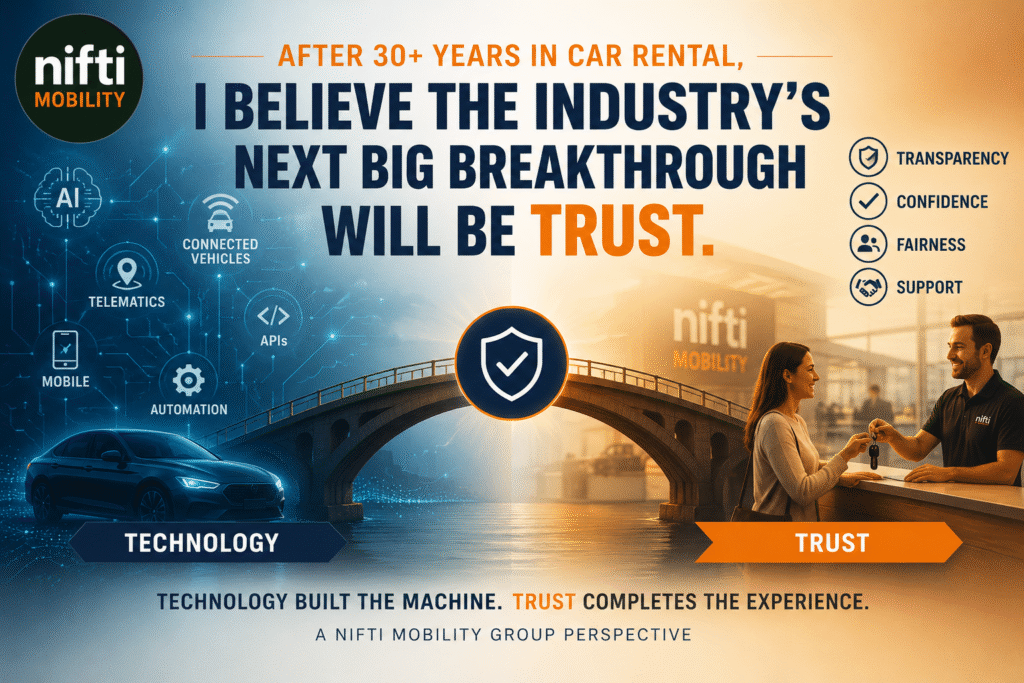
The car rental industry’s next major breakthrough won’t only be technology, it’ll be trust. This isn’t an anti-technology argument at all, quite the opposite, actually.
The car rental industry has spent decades investing in technology, and much of it has been incredibly important. Computerized reservation systems, GDS connectivity, broker and OTA distribution, revenue management, fleet systems, rental management software, mobile apps, digital agreements, loyalty programs, counter bypass, contactless rental, telematics, connected vehicle data, AI pricing, fraud tools, damage tools, toll integrations, EV tools, and automation have all helped modernize the business.
Those systems help companies price better, distribute faster, manage vehicles more efficiently, reduce manual work, improve fleet visibility, and serve customers at scale. But here’s the part we need to talk about next: A booking can be digital and still feel confusing, a vehicle can be connected and still leave the customer wondering what will happen if there’s a dispute, and a company can have excellent internal systems and still fail to make the customer feel fully informed.
In this technology-driven, interconnected, car rental world a big opportunity exists.
The industry has improved. The customer still has questions. There’s serious argument that car rental hasn’t dramatically improved.
Mobile apps are better, reservation flows are better, some customers can skip the counter entirely, digital agreements are more common, fleet technology is more advanced, telematics can show fuel, mileage, vehicle location, battery condition, maintenance issues, (and more), AI and revenue management tools can help operators make smarter, quicker, pricing and fleet decisions.
In many cases, the rental experience today is far better than it was years ago. But many customers still approach car rental with the same familiar questions we’ve seen for decades:
- What am I really going to pay?
- Why’s the final total different from what I expected?
- Do I need this insurance or don’t I?
- Why is there such a large hold on my card?
- Can I use a debit card here or not?
- Who’s actually providing the car?
- Who helps me if I booked through a third party?
- What happens if my flight’s late?
- Am I responsible after an after-hours return?
- Why did a toll, fuel, cleaning, or damage charge appear later?
- If there’s a dispute, what evidence will I actually see?
That’s a lot of uncertainty for a product that often begins after a flight, during a trip, under time pressure, with luggage in hand and children asking if the hotel has a pool. And it’s a lot to process when all the customer really wanted was a car, not a minor in rental operations.
The customer may not understand the difference between an OTA, a broker, a brand, a licensee, a franchise location, a local operator, a toll processor, a payment hold, collision damage waiver, supplemental liability, a deposit, a prepaid voucher, and a rental agreement. And, why would they? Why should they?
The industry understands these distinctions because we live inside them. The customers don’t. They simply want the vehicle they booked, at the price they expected, with rules they can understand, and support they can find if something goes wrong. That’s really not unreasonable. The real problem isn’t that car rental lacks technology.
For years, the industry has treated technology mainly as an operational advantage, in my view.
Can we take more reservations? Can we update rates faster? Can we distribute through more channels? Can we forecast demand better? Can we reduce counter time? Can we locate vehicles? Can we recover missing cars? Can we automate tolls? Can we capture fuel and mileage? Can we identify fraud? Can we optimize fleet utilization? Can all these systems connect seamlessly?
These are all important questions and operators need answers to them. Without operational technology, car rental becomes slower, riskier, and less scalable. But many of these tools were designed primarily for the company, the operator, the broker, the platform, or the fleet manager. So the next question is different:
Can the same technology also help the customer trust the rental?
Because “the system says so” isn’t exactly the warm blanket of customer confidence.
That’s where I believe the industry is heading – not technology for technology’s sake. Not automation that makes customers feel processed. Not connected vehicles that feel like surveillance. Not AI that makes pricing feel mysterious. But technology that makes the rental easier to understand, easier to compare, easier to complete, and easier to trust. That’s the next layer.
Trust breaks in small moments.
The trust problem in car rental is rarely one giant dramatic event, it’s usually a pileup of small uncertainties: The rate looked good, but the total changed somehow – at least in the customer’s view. The insurance explanation was technically accurate, but not understandable. The debit card policy was somewhere in the terms, but not obvious enough. The deposit was disclosed, but not in a way the customer absorbed before arriving. The customer booked through one company, picked up from another, signed a contract with a third, and called a fourth when something went wrong. The car was returned after hours, but the customer didn’t know when responsibility ended. A toll charge appeared later with an admin fee attached. A damage claim arrived after the trip, and the customer wondered whether anyone had looked closely at the car before or after their rental. Nobody wakes up excited to become a forensic accountant for a three-day economy rental.
None of these issues are new and anyone who has worked in rental knows them. Anyone who’s rented enough cars has probably experienced at least one of them. The important point is not that every company handles these issues badly. Many don’t. Many operators work hard to be fair, clear, and responsive. The point is that the categories keep repeating.
And when the same categories keep repeating, the industry shouldn’t only ask, “How do we handle the complaint?” And the response shouldn’t always be “it was in the terms.” It should ask, “Why did the customer feel exposed in the first place?” The next layer: technology-enabled trust. I think the future of car rental technology needs a new lens:
Technology-enabled trust.
That means using technology not only to improve internal operations, but to create customer confidence at every single stage of the rental. For example:
- Price Trust
The customer should understand the real cost as early as possible- not just the base rate or the attractive daily price. The real cost.
Mandatory fees, optional products, taxes, airport charges, young driver charges, additional driver charges, fuel rules, toll programs, prepaid vs. pay-later differences, and behavior-triggered charges should be clearer before the customer commits. A good rental experience shouldn’t begin with a math ambush.
- Policy Trust
Rental policies aren’t light reading, they’re more like legal lasagna in a way: many layers, some cheese, and a lot going on underneath. Delicious in theory. Heavy in practice.
Deposits, debit card rules, credit card holds, insurance options, mileage limits, cancellation rules, after-hours returns, local renter restrictions, geographic restrictions, and age policies all matter. Technology can help by turning policy into plain language. Not “please review paragraph 14 subsection C.”
More like:
“Here’s what you need to bring.” “Here’s what will be held on your card.” “Here’s when the hold is usually released.” “Here’s exactly what protection you selected and what it means in plain language.” “Here’s what’s still your responsibility and why” “Here’s what changes if you return after hours.” “Here’s what the total is if you’re 23 years old and have 2 additional drivers.”
That’s not dumbing it down, it’s respecting the customer’s time.
- Provider Trust
Modern rental distribution is powerful, but it can be confusing. A customer may shop on one site, book through another platform, pick up from a local operator, and sign a rental agreement with a company name they didn’t notice during booking. The industry understands this structure, more or less. But the customer often doesn’t.
The customer should know:
- Who’s the actual rental provider?
- Who controls the local policies?
- Who charges the card?
- Who handles changes?
- Who handles refunds?
- Who handles complaints?
- Who handles damage disputes?
Distribution technology helped customers compare more options. The next step is helping them understand who stands behind the option they selected.
- Process Trust
Pickup isn’t just a transaction, it’s a handoff.
The customer wants to know where to go, what to bring, how long it will take, what happens if their flight is delayed, where the shuttle is, how after-hours return works, and whether the vehicle will actually be there. Mobile check-in, counter bypass, kiosks, digital agreements, and contactless rental all help but speed alone isn’t enough.
The best process technology should answer the customer’s next question before they have to ask it.
- Vehicle Trust
To be clear, the vehicle is the product. The customer wants a clean, safe, reliable car that matches the booked category closely enough to feel fair. The operator wants utilization, fleet control, maintenance visibility, damage protection, and fast turnaround. Connected fleet data can help both sides.
Vehicle health, odometer, fuel or EV charge level, maintenance alerts, tire pressure, location, and readiness information can support not only internal fleet decisions, but customer confidence. A connected fleet shouldn’t just be smarter for the operator, it should feel more reliable to the renter.
- Evidence Trust
This may be the biggest opportunity of all. Some of the most frustrating rental disputes come down to evidence:
- Was the car returned on time?
- What was the fuel level?
- What was the odometer reading?
- Was the vehicle damaged before pickup?
- Did something happen during the rental?
- Was there a smoking event?
- Was a toll actually incurred?
- Was the vehicle returned after hours?
Historically, customers often felt like the company had the file, the photos, the timestamps, the inspection notes, and the leverage. Technology can change that. Imagine every rental producing a simple, customer-facing record:
- checkout timestamp
- return timestamp
- fuel or EV charge level
- odometer reading
- visible condition record
- selected policies
- toll guidance
- return confirmation
- exception notes, if any
Not a 14-page data dump and not a mysterious invoice (that sometimes arrives in another language 2 weeks after you returned home). A plain-language rental record.
That wouldn’t eliminate every dispute but it would reduce the feeling that charges come from a black box. Especially when the black box has your credit card number.
- Support Trust
One of the most underrated questions in car rental is: Who owns the problem?
If a booking came through a broker, an OTA, a travel agency, a white-label platform, or a local affiliate, the customer may not know who to contact when something goes wrong. That’s not just a service issue, it’s a trust issue.
Support ownership should be visible, refund status should be trackable, dispute steps should be understandable. Customers shouldn’t need to become industry detectives to solve a rental problem.
Most customers didn’t pack a magnifying glass with their carry-on.
The Sherlock Holmes rental experience is memorable, but not in the way we want.
- Data Trust
Connected vehicle data can be incredibly valuable.
It can help operators find vehicles, manage fleets, verify fuel and mileage, monitor maintenance, recover cars, detect impact, support claims, reduce disputes, and I’m sure tons of other things I’m not thinking of at the moment.
But connected data can also damage trust if customers feel secretly monitored, automatically penalized, or poorly informed. The difference is transparency.
Customers should understand what data is collected, why it’s collected, when it’s collected, how it may be used, and what human review exists before penalties or claims are applied.
Telematics can become trust infrastructure only if it’s paired with disclosure, fairness, and common sense.
- Operator Trust
This matters especially for independent, regional, and local operators.
Large brands often benefit from name recognition, loyalty programs, airport presence, and customer familiarity. Smaller operators may offer excellent service and value, but customers may hesitate if they’re unsure about professionalism, policies, support, or reliability.
A trust layer could help good independent operators compete.
Verified policies, technology readiness, evidence-backed returns, clear deposits, transparent provider identity, and documented support paths could make a local operator feel safer to book.
That’s good for customers, good for operators, and good for a healthier marketplace.
Telematics: from fleet control to customer confidence
Telematics may be one of the most important examples of this shift.
For operators, the value is obvious. Telematics can help with location, recovery, odometer readings, fuel levels, EV battery state, diagnostics, utilization, maintenance, geofencing, impact events, smoking detection, and more. That’s already useful. But the bigger opportunity is translating some of that data into customer confidence.
If a vehicle’s fuel level, mileage, return time, location, and certain condition indicators can be verified digitally, then why should the customer experience those items only as potential charges after the fact? Why not use the data to create a clearer rental record, where possible?
Why not help customers feel protected from mistaken fuel charges, unclear mileage charges, questionable return timing, or unsupported damage claims?
Why not show that the operator is evidence-ready and professionally managed?
This is the important shift:
The same data that protects the fleet can also protect the customer relationship. But only if it’s presented correctly.
If connected vehicle data is hidden, confusing, or used only as an enforcement tool, it can feel creepy. If it’s disclosed clearly and used fairly, it can feel protective.
That’s the line the industry has to walk & I have no doubt that some of those discussions have taken place.
The missing layer is translation
Here’s the simplest way I can put it: The industry already has pricing systems, what it needs is price trust. The industry already has policy rules, what it needs is policy translation. The industry already has fleet data, what it needs is customer-visible evidence. The industry already has distribution networks, what it needs is responsibility clarity. The industry already has support teams, what it needs is obvious support ownership. The industry already has technology, what it needs next is technology customers can feel. A customer should not need 30 years of rental experience, like I have, to understand a rental.
Why this matters commercially
Trust isn’t just a nice idea and it’s not a soft, fluffy, “wouldn’t it be lovely” concept. Trust is commercial infrastructure. Not the fluffy conference-panel kind. The real kind that reduces angry phone calls.
When customers trust the process, they’re more likely to book. When they understand the price, they’re less likely to abandon. When they understand the policy, they’re less likely to argue at the counter. When return records are clear, they’re less likely to dispute charges. When evidence is shared fairly, they’re less likely to feel cheated. When support ownership is obvious, they’re less likely to bounce between companies in frustration. When independent operators can prove professionalism, they can compete on more than price. When brokers and OTAs can show clearer provider and policy information, their marketplaces become stronger. When technology vendors help operators build customer confidence, they move from back-office suppliers to strategic growth partners.
That’s the business case.
Technology-enabled trust can reduce friction, complaints, chargebacks, service volume, review damage, and customer hesitation. It can improve conversion, loyalty, repeat behavior, partner confidence, and operator credibility. This isn’t charity, it’s good business. Period.
The broader mobility picture
Car rental no longer lives in its own little lane.
Customers compare rental cars with rideshare, peer-to-peer car sharing, subscriptions, long-term rentals, dealer rentals, replacement rentals, EV access, local mobility options, and whatever new vehicle-access model someone will invent next Tuesday. Car rental has always competed with public transportation. That means the industry isn’t only competing on fleet and price. It’s competing on clarity.
Which option is easiest to understand? Which option feels safest to rely on? Which option gives the customer confidence if plans change? Which option explains the rules before the customer is trapped at a counter? Which option provides evidence instead of surprises?
The future of mobility will not be won only by whoever has the best app, the smartest pricing, or the most connected vehicles. It’ll be won by companies that make complex mobility feel simple, fair, and trustworthy.
Car rental has a major advantage here: it remains a valuable, flexible, practical product. It gives customers freedom and control in a way many alternatives don’t.
But the industry has to make that value easier to understand and easier to trust.
Where Nifti Mobility Group fits into this conversation
At Nifti Mobility Group, we’re thinking seriously about the future of vehicle access, rental clarity, operator readiness, customer confidence, and smarter comparison. That doesn’t mean the answer is one product, one platform, one score, one app, or one vendor.
The bigger idea is this: Car rental and mobility need a clearer trust layer. A layer that helps customers understand what they are buying, a layer that helps operators show they’re ready, professional, and transparent, a layer that helps technology companies connect their tools to customer confidence, not just operational efficiency, a layer that helps brokers, OTAs, travel agents, and mobility platforms make the actual rental experience easier to compare and easier to explain.
This isn’t about attacking the industry at all – it’s about being a part of strengthening it.
Car rental is too useful, too important, and too misunderstood to leave trust as an afterthought.
The opportunity ahead
If I had to summarize the next generation of winning car rental technology in one sentence, it would be this:
It won’t merely optimize the operator’s decision, it’ll make the customer feel safer saying yes.
The next wave of technology should absolutely help operators run better businesses. But it should also help customers understand the rental before, during, and after the trip. It should turn confusing policies into plain language, it should turn hidden operational data into useful customer-facing evidence, it should turn provider complexity into responsibility clarity, it should turn connected vehicles into trust infrastructure, and it should turn the rental from something customers tolerate into something they understand.
I believe it’s one of the biggest opportunities in the industry.
The future may be powered by data, but it will still be judged by how the customer feels when the keys are handed over.
Because after decades of faster systems, smarter fleets, better pricing, broader distribution, and more automation, the next breakthrough may be the most human one of all:
The future of car rental may be powered by technology. But it will be won by trust.
By Brett Gould
Founder, Nifti Mobility Group
Let's Connect
We’re not just building our own thing — we’re helping others build too. If you’ve got something bold, different, or disruptive in car rental, we’re already interested.
We’ll reply personally & quickly to any serious submission – and we thank you for taking the time to reach out.
Nifti Mobility Group, LLC
Biddeford, Maine, USA
info@niftimobility.com
Stay In The Loop
© 2025 Nifti Mobility Group. All rights reserved.